
The maintenance plan for production plants
The term maintenance, as stated in the UNI EN 13306 norm, refers to the “combination of all technical, administrative and managerial actions during the life cycle of an item intended to retain it in, or restore it to, a state in which it can perform the required function”. The word “item” is a synonym for machinery and it refers to a piece of equipment or the plant that undergoes the maintenance activities.
The goal of the maintenance is to assure that the items are reliable, that is, as stated in UNI EN 13306 and UNI 9910 norms, the “ability of an item to perform a required function under given conditions for a given time interval”.
To accomplish the mission of the maintenance process and complete the strategic goals of availability of the items, and of repair and setting up costs control, these actions must be “well thought through”. This means creating a balanced maintenance plan, both in a technical and in an organisational way.
The identification of the perfect maintenance policy mix comes as a result of the knowledge of the maintenance team of how the whole process works. It’s only by starting from a good plan that it is possible to identify the requirement of these strategies in terms of human resources and organisational and economic forms.
Industrial maintenance policies
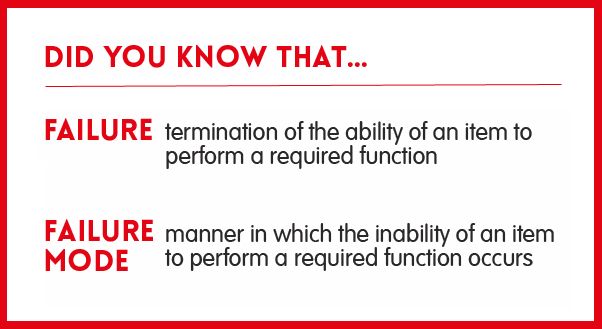
The planning and application of a maintenance plan help to define when people have to intervene on a machinery with an operation only when in failure mode and when, instead, it’s more appropriate to prevent its failure with a preventive maintenance action.
Different approaches to this choice bring to the identification of 2 different canonical strategies, of which we now give the definitions.
- Corrective maintenance (failure mode): maintenance carried out after fault recognition and intended to put an item into a state in which it can perform a required function;
- Preventive maintenance: maintenance carried out at predetermined intervals or according to prescribed criteria and intended to reduce the probability of failure or the degradation of the functioning of an item.
The preventive maintenance policies can be divided into 3 subcategories:
- Predetermined maintenance, which is “carried out in accordance with established intervals of time or a number of units of use but without previous condition investigation” (i.e. changing the oil filter of a car every 20.000 Km);
- Condition based maintenance which includes “a combination of condition monitoring and/or inspection and/or testing, analysis and the ensuing maintenance actions”. It is an action taken upon the real state of wear of an item’s component (i.e. a brushless motor that presents an abnormal absorption);
- Predictive maintenance, which is a “condition-based maintenance carried out following a forecast derived from repeated analysis or known characteristics and evaluation of the significant parameters of the degradation of the item” (i.e. the inspection of a motor based on its vibrations or the oil temperature).
When planning or carrying out these maintenance policies, Renovis Replace & Repair represents a great help for a firm’s maintenance department as it inspects, repairs, and sells electronic component replacements for industrial automation.
Thanks to its express repair services and exchange policy, Renovis can promptly satisfy urgent corrective maintenance actions due to unexpected and unpredictable faults, especially when the replacement of an outdated product can cause problems for the item and the whole plant.
Renovis comes to the rescue of companies that planned a preventive maintenance by selling, repairing, and inspecting industrial components, and by creating replacement pieces from your own faulty products that we substitute, fueling your replacement warehouse and creating a continuous flow of spare parts, even if outdated, that couldn’t be obtained in any other way.
Visit our website or get in touch with our selling network to learn more about our services.
